
Road Camp 12: the 1967 Berrydale prison fire
38 men died at Road Camp 12 on July 16, 1967. The documents survive. Follow the people, examine the evidence, and explore what remains unresolved.
Read the research guide and source tables ↓Enter the investigation ↗Remember the menA separate controlled test after Berrydale. Not a photograph of the July 16 fire. Original watermark and caption retained.
A short way in.
Every record opens
another question.
Switch between research trails. Each connection shows why two records belong in the same investigation—and what they cannot settle alone.
One night.
A long aftermath.
Don’t just read about it.
Examine it.
Turn the photograph over, zoom into its details, and select the highlighted caption to connect the image to its context.
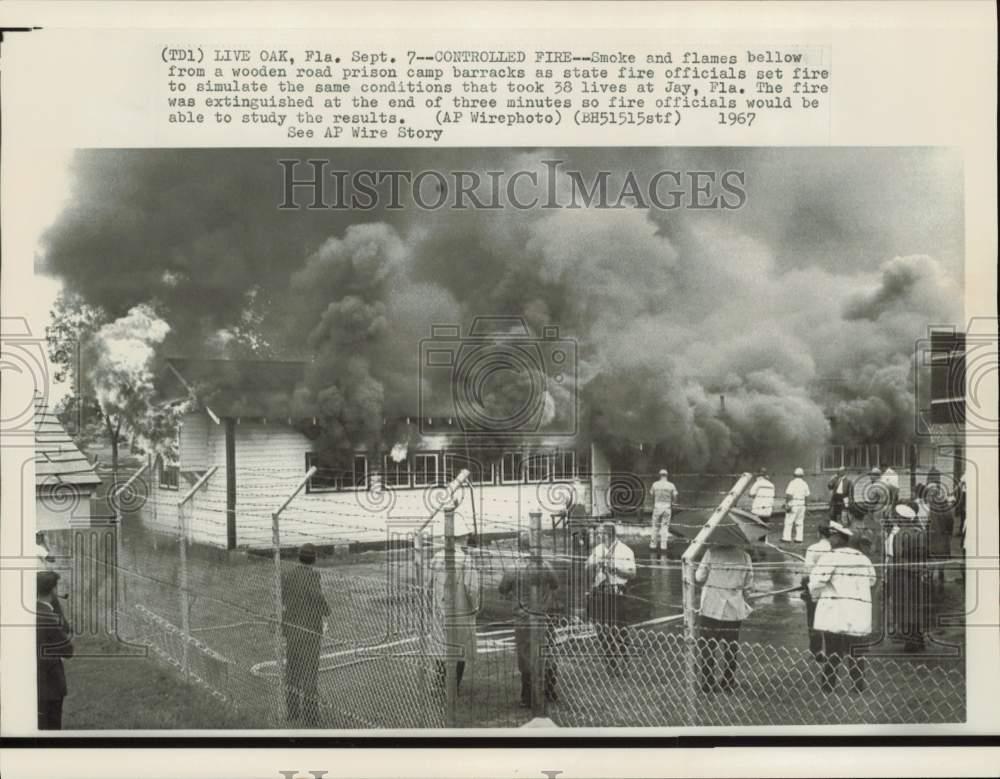
Original image and watermark preserved. This is not the Berrydale fire.
When the records
don’t line up.
A change in a reported number and an unresolved identifier are different kinds of discrepancy. Compare each in its own context.
Descriptions below summarize the archive’s records. They are not quotations from the original documents. Follow the source links to inspect the underlying evidence.
Remember the men.
Open a name to read what the preserved records establish. These are documented lives, not anonymous entries in a death toll.
Names follow the archive's source-linked index. Spelling conflicts and limits remain visible in each profile.
Your evidence desk.
Search the preserved collection or filter by source type. Open a record to follow it into Crypt of Echoes.
What are we still looking for?
An open question is a starting point. Expand each one to follow the research.
Why do the death logs say “RP 32”?
The preserved death-log description identifies an RP 32 notation. Its relationship to the camp described in newspapers as Road Camp 12 remains unresolved. Camp identifiers need to be reconciled against original institutional records.
Inspect the death-log record ↗What do the investigation files leave out?
The archive's research guide identifies missing appendices, family correspondence, keys and safety implementation, rescue records, identification and burial, and other routes for further reporting.
Open the research leads ↗Which records have been requested?
The preserved October 14, 2026 request ledger tracks 16 agency/reference routes and 46 dated events. Read the ledger for that snapshot; current request status must be checked against later correspondence.
Read the request ledger ↗Road Camp 12: evidence, chronology and open questions
What happened at Road Camp 12 in 1967?
On July 16, 1967, a fire at the road-prison camp associated with Berrydale and Jay, Florida, killed 38 men. This investigation brings together contemporary newspapers, state investigation files, prison death logs, photographs and later official records. The purpose is to let readers follow an account back to its evidence, compare disagreements and see what the surviving material leaves unanswered.
The central state file is S923, box 23, folder 7: Governor Kirk correspondence and investigation material. Its 21 supplied pages include a Division of Corrections special-investigation progress report, cabinet committee material and emergency-plan documents. The enclosed investigation dates the fire July 16; the archive explicitly notes a different date in the covering correspondence. The report and correspondence are historical accounts by their authors, not independent findings by this archive.
Why do accounts say 37 deaths or 38 deaths?
The Big Spring Daily Herald report of July 17, 1967 carried an early count of 37. The National Fire Protection Association’s May 1968 review of the major fires of 1967 recorded 38 deaths. The memorial index on this page follows the 38 names in the Division of Corrections investigation. Keeping the publication dates beside the numbers helps distinguish early reporting from a later institutional review.
The two totals should not be silently combined or treated as interchangeable. These sources establish that different counts were published; by themselves, they do not establish exactly when or why the count changed. The preserved newspaper clipping and the NFPA issue remain available so readers can inspect the wording and context. NFPA’s discussion is an institutional summary, not the underlying witness testimony or complete inquest.
Road Camp 12 and the unresolved “RP 32” notation
The Florida State Prison Death Logs preserve a 14-image sequence, with fire-related entries on scan pages 5 and 12. The handwritten record labels the fire deaths “RP 32.” Its relationship to the camp described as Road Camp 12 has not been reconciled. Retaining both identifiers makes the uncertainty visible and gives researchers additional terms to check in institutional indexes.
The register also contains an escape page and entries outside the simplified date range in its title. Readers should use the page references and transcription warnings rather than assume every row describes this fire. Faint handwriting and uncertain spellings remain. A matching name or camp number is a lead to evaluate alongside the original image, not sufficient proof of a person’s biography, role or responsibility.
Investigation, safety recommendations and the Live Oak test
The Board of Commissioners file, S1805, box 8, folder 6 contains 14 supplied pages of reports, draft minutes, safety recommendations and correspondence from July–August 1967. Read it alongside the governor’s file to separate the immediate investigation from the subsequent administrative response. A recommendation, authorization or proposed expenditure does not by itself demonstrate that work was carried out.
The photograph featured above depicts a controlled barracks-fire test at Live Oak on September 7, 1967. It does not show the July 16 Berrydale fire. Its caption, reverse and watermark are part of the preserved object. The later test can inform questions about the official response, but its conditions and observations cannot simply be substituted for conditions inside the Berrydale barracks.
Questions about keys, exits, inspections, water supply and rescue therefore require their own evidence. The archive’s research guide identifies missing appendices, inspection material, training records and the fuller Live Oak test record as specific routes for investigation. Those are research leads; their appearance in a list does not mean the records have been located.
Remembering the victims and tracing the aftermath
The 38 names below link to source-based profiles. They preserve the roster’s spelling while keeping conflicts and biographical gaps visible. Ages, family histories and individual actions should not be filled in by assumption. Where an official report reproduces an allegation or an inquest conclusion, the profile attributes it to that record and explains its limits. An inquest finding is not a criminal conviction.
The later 1969 House Journal entries for HCR 1954 document the legislative progress of a commendation for Captain Calvin E. Ellison. The supplied pages cover introduction, adoption, enrollment and filing. The commendation credits emergency aid without establishing a verified number of lives saved; the journal pages are not the complete supporting legislative file.
Family correspondence, identification, burial, rescue and possible compensation each leave a different documentary trail. Research should keep those questions separate. An official’s summary of a family’s concern is not the same evidence as the family’s own letter; a burial lead is not a confirmed disposition. The public Records Chase ledger brings together dated requests and responses, while the October 14 request ledger remains a historical snapshot.
How to use and cite this investigation
Start with the source that supports the particular statement you want to check. Record its title, creator or agency, date, archive identifier and relevant page. Follow the evidence links to the preserved files and review notices. A source’s creation date, the date the archive received it and the date a research view was compiled describe different events.
Some source pages provide checked reading copies; others contain machine-extracted text or first-pass transcriptions with stated limitations. Searchable text helps locate a passage, but the scan remains essential when a name, number or quotation matters. This page is an editorial guide to the collection, not a complete transcript of the investigation or a verdict about responsibility. The archive methodology explains preservation, context and corrections.
The 38 victims: source-linked memorial index
Names follow the investigation’s roster. Open an individual profile for the supporting source and any spelling or identity limitations.
- Thomas Eugene Ard
- Charles James Blossom
- Archie Lee Chister
- Lester Cleves
- David Franklin Cole
- Jimmy Copeland
- James Cunningham
- Charles Edward Delain
- Vincent B. Dovico
- Earl Evans
- Eddie B. Gable
- Jesse Gray
- Bobby Lee Hall
- George Edward Hall, Jr.
- Eugene Hamilton
- Harrell Arthur Harp, Jr.
- Donald Wayne Harper
- Robert Henn, Jr.
- James Hill
- Earl Frank Hoffman
- Albert Ivery
- Mack Laster
- Willie Nelson Leslie
- Johnny Lewis
- John Lee McFarlin
- Reginald Milton McGuire
- Lee Andrew Mitchell
- Ronnie Nichols
- Jessie Osburn
- Charles Palmer
- Felix Randall
- Drell Rivers, Jr.
- Isac Robinson
- Johnnie Simmons
- Tommy Day Smith
- Albert Truluck
- Ruben Williams
- Joseph Wynder
Road Camp 12 evidence and research sources
The following index is the source set used by this data view. Historical records, later contextual material and the archive’s own research annotations retain their distinct descriptions.
- Road Camp 12 — further evidence and custodians to pursue
- Road Camp 12 — public records request and response ledger
- Berrydale fire people index — Identification work and legislative participants
- Berrydale fire people index — Safety officials, responders and reporting
- Berrydale fire people index — Officials, investigators and families
- Berrydale fire people index — The 13 surviving prisoners
- Berrydale fire people index — The 38 victims
- HCR 1954 — Florida House Journal entries commending Captain Calvin E. Ellison (1969)
- Road Camp 12 fire — Governor Kirk correspondence and investigation report, S923, box 23, folder 7
- Road Camp 12 fire — Board of Commissioners minutes, S431, volume 32
- Road Camp 12 fire — Board of Commissioners records, S1805, box 8, folder 6
- Berrydale Road Camp 12 fire — Pensacola newspaper pages, July 17–21, 1967
- Louie Wainwright recalls the Road Camp 12 fire — FDC History Museum interview
- Live Oak: investigators recreate a barracks fire
- Berrydale: the aftermath of the Road Camp 12 fire
- After Three Years — libraries in Florida state institutions, 1969
- Florida Division of Corrections — education development plan, 1967
- State Road Prisons Original Register, 1957–1962
- Florida State Prison Death Logs, 1960–1972
- Floridoje sudegė 34 kaliniai - Laisvė / Liberty, July 21, 1967, page 1
- Pen Fire Kills 37 - Big Spring Daily Herald, July 17, 1967, page 1
- Fiery Death Trap
- Charred Bars
- Georgia Begins Prison Camp Investigations
- Jury Charges Prison Fire Set By 3 Convicts
- Convicts, Guards Tell Of Fatal Prison Fire
- Prison Inferno Plotted, Fire Survivors Testify
- Fort Walton Beach microfilm photographs - Road Camp 12 source register
- Deadly Prison Fire in Florida (1967) — preserved eFootage preview
- Cons Testify Cellmates Set Deadly Blaze — Big Spring Daily Herald, July 18, 1967, page 12
- Big Spring Daily Herald — July 18, 1967 — complete issue
- Fire Safety in Correctional Facilities — Berrydale fire account
- Florida Senate Journal — commendation for Captain Calvin E. Ellison, Road Camp 12 fire
- Berrydale prison fire — four newspaper clippings
- An Inventory of Correctional Facilities Within Florida — Report 19-08
- The Major Fires of 1967 — Berrydale prison barracks