Compare reading text with the preserved source. Line breaks and spacing are retained; long lines wrap to fit the screen. A file's role does not establish that its text has been checked.
Transcription — service-mss-maj-01019--01019_0178_0179.pdf
Reading transcription · Review label: Known limitations
Library of Congress
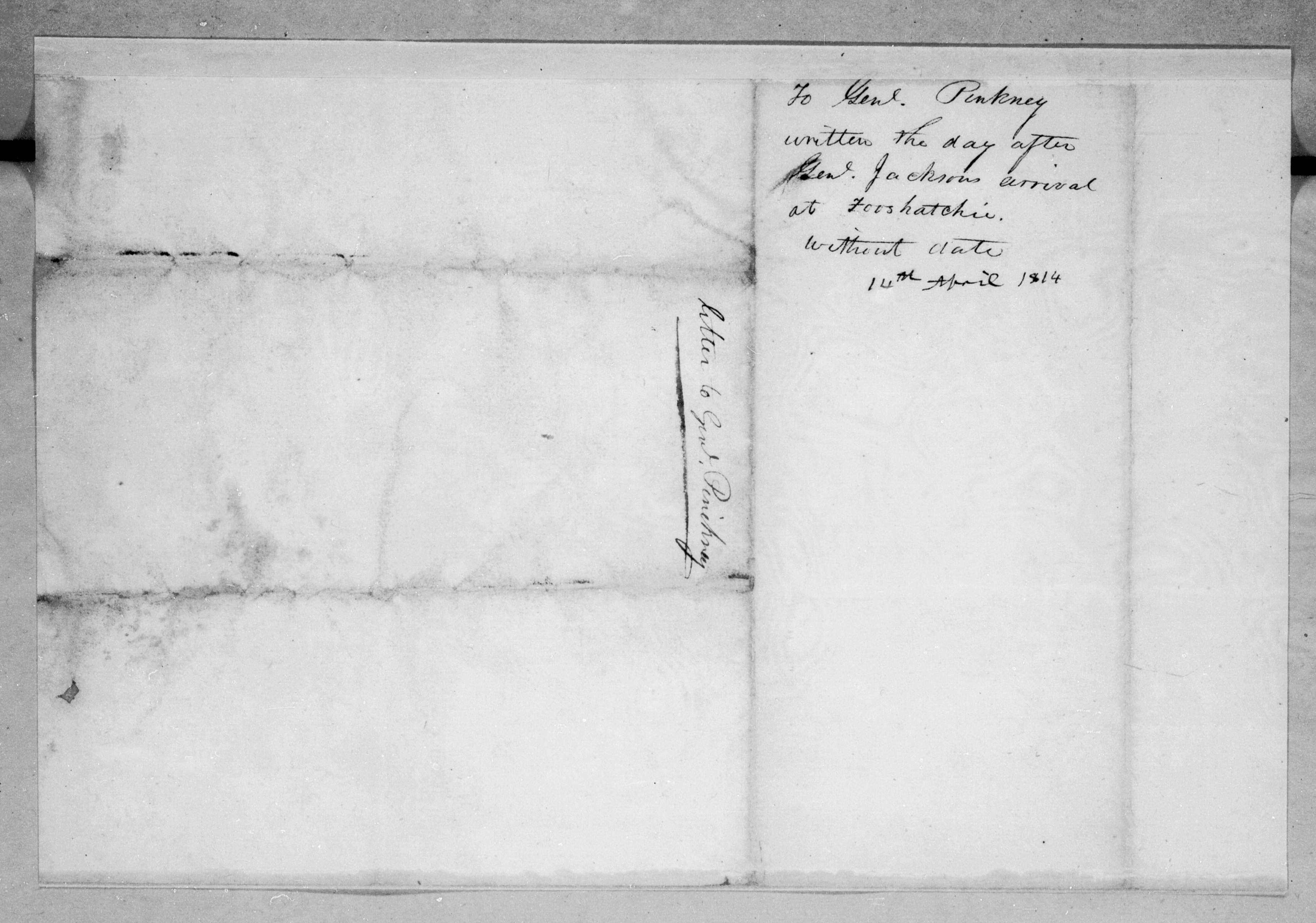
Andrew Jackson to Thomas Pinckney, April 14, 1814,
from Correspondence of Andrew Jackson. Edited by
John Spencer Bassett.
TO THOMAS PINCKNEY.1
1 Copy.
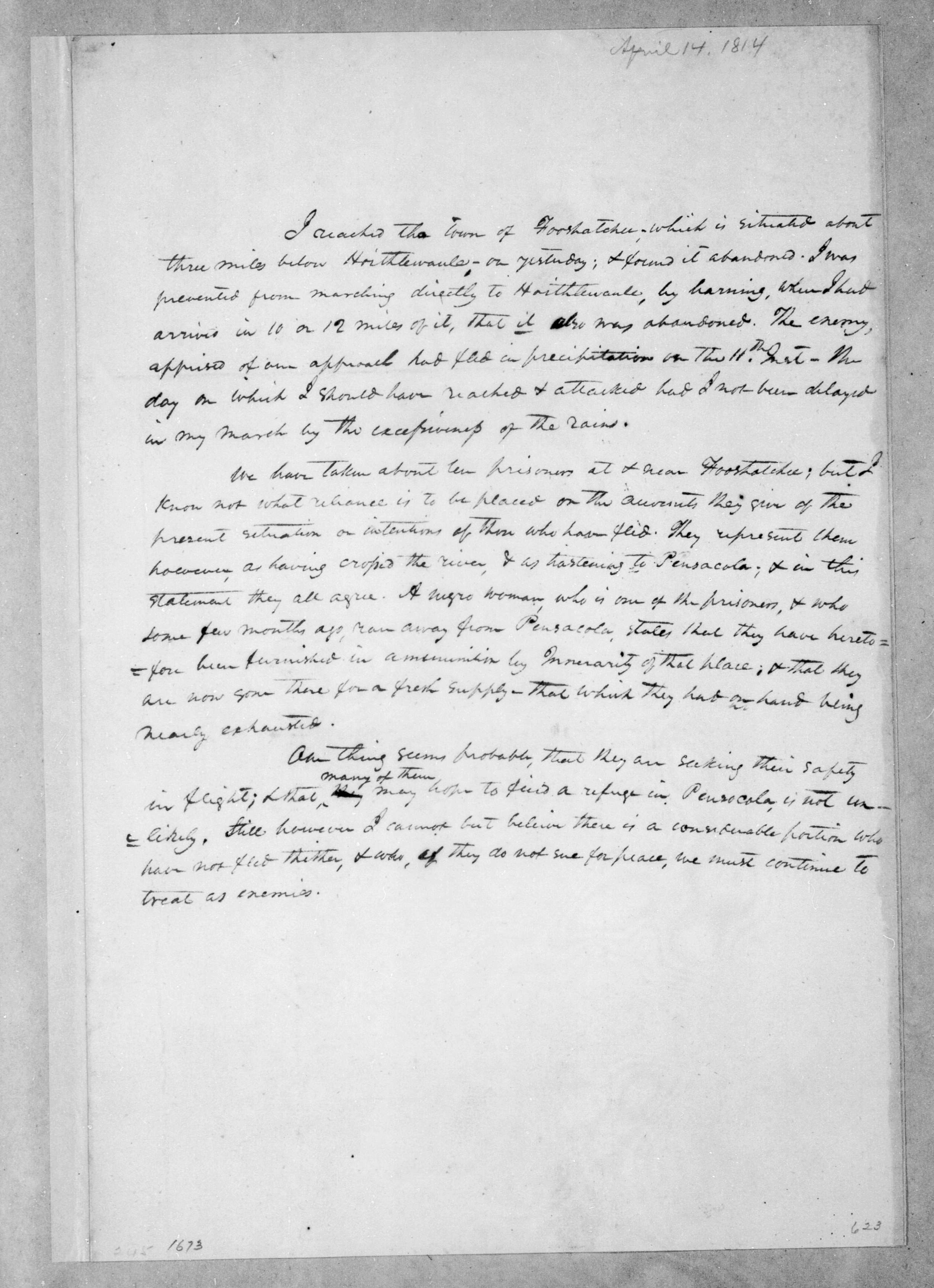
Fooshatchee, April 14, 1814.
I reached the town of Fooshatchee, which is situated about three miles below
Hoithlewaule, on yesterday; and found it abandoned. I was prevented from marching
directly to Hoithlewaule, by learning, when I had arrived in 10 or 12 miles of it, that it also
was abandoned. The enemy, apprised of our approach had fled in precipitation on the
11th. Inst, the day on which I should have reached and attacked had I not been delayed in
my march by the excessiveness of the rains.
We have taken about ten prisoners at and near Fooshatchee; but I know not what reliance
is to be placed on the accounts they give of the present situation or intentions of those who
have fled. They represent them however, as having crossed the river, and as hastening
to Pensacola; and in this statement they all agree. A negro woman, who is one of the
prisoners, and who some few months ago, ran away from Pensacola, states that they have
heretofore been furnished in ammunition by Innerarity2 of that place; and that they are
now gone there for a fresh supply, that which they had on hand being nearly exhausted.
2 James Innerarity, a Scot, leading clerk in the establishment of Panton, Leslie, and
Company. See Am. Hist. Rev., II. 701.
Andrew Jackson to Thomas Pinckney, April 14, 1814, from Correspondence of Andrew Jackson. Edited by John Spencer Bassett. http://
www.loc.gov/resource/maj.01019_0178_0179
�Library of Congress
One thing seems probable, that they are seeking their safety in flight; and that many of
them may hope to find a refuge in Pensacola, is not unlikely. Still however I cannot but
beleive there is a considerable portion who have not fled thither, and who, if they do not
sue for peace, we must continue to treat as enemies.3
3 The following memorandum, seemingly in the handwriting of Maj. John Reid, shows the
way Jackson took vengeance on the Indian villages and incidentally gives us an idea of
the geography of the Creek Country at the time.
“Ra,chue,cul,law, or old Field Town about 7 miles so. eastwardly from Fort Williams
contained 2 Towns or villages 1½ miles apart. Burned by Lt. Col. Gibson 21st march 1814
“22 and 23 Genl. Johnson Burnt ren,chaw,la or parish creek Town about 15 miles so. so
Et of Fort Williams—and We,hoof,ka, or Muddy Creek Town on the waters of Hatchet, or
Putch[. . . . ]che [Puttushatchee] Creek consisting of Two villages about 12 miles apart
these are about So Et. 18 miles from Fort Williams.
“Apl. II. On the march of the army Towards the Junction Burned a small village on
We,wo,kee, or falling Creek—3 miles above the main Town of that name.
“13th arrived at Foushatchee, or Bird Creek, Town on the North side of the Tallapoosa
about 3 miles below the Haith,le,wal,la Town and burned that Town, and The Coolooma
Town.
“14 Burned the Hoith,le,wal,la
“15. Burned the Ecua, hat,ke, or white ground, Town also the Muclessee Town—from
Cooloo,ma to muclessee is about 5 miles. The white ground Town is between them “There
are Towns on the south side of Tallapoosa corresponding with those on the north, bearing
the same names—also on the south side is a Shawnee Town the whole of which with
several other settlements not known by any particular name, were burned while the army
Andrew Jackson to Thomas Pinckney, April 14, 1814, from Correspondence of Andrew Jackson. Edited by John Spencer Bassett. http://
www.loc.gov/resource/maj.01019_0178_0179
�Library of Congress
lay near Foushatchee and on its march to Tuskegee at the old French Fort Toulouse, near
the junction. Here stands the site of Fort Jackson, now Erecting.
“From Tuskegee a party was dispatched under Majr. Gibson by which the Towns of
Coosawda E,cur,cha,ta—Too,was,sa—Pau,wat,ha and attaussee were burned on the
north of the alabama. There are four Towns on the south sid
Download this text file with its original spacing ↓
Only a preview is loaded on this record page. The linked reading pages contain the remaining text and work without JavaScript.